Phantom Miniatures
Alexander Brix Tillegreen
A new immersive audio commission by Alexander Tillegreen supported by The Space and Danish Composers Society, transforming psychoacoustic illusion into live performance and digital presentation.
Phantom Miniatures is a collaboration with composer Alexander Brix Tillegreen, that brings one of psychoacoustics’ most uncanny phenomena into both the concert hall and the digital sphere. Supported by The Space and Danish Composers Society, the project presents the phantom word illusion, in which listeners perceive imaginary words shaped by their own as a live, spatialised performance and a suite of short-form digital videos created for online audiences worldwide, which were released on the ensemble’s YouTube channel in March 2026.
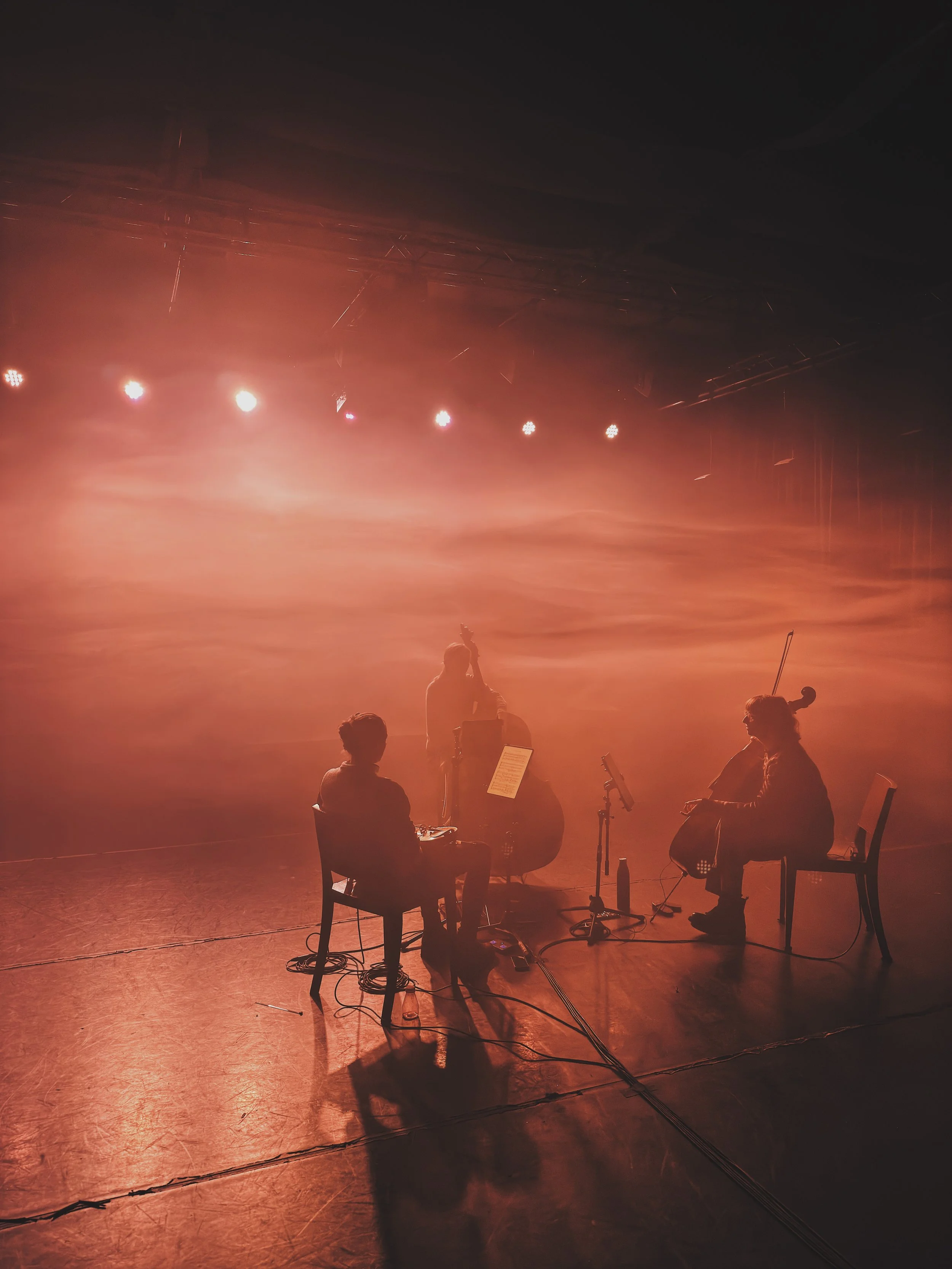
Tillegreen’s artistic research into perceptual illusions has appeared in galleries, festivals, and installation settings across Europe; this new iteration marks the first time the work has been created specifically for live musicians and immersive electronics. The filming, mixing and digital realisation of the project took place at Southby’s Soundscape Studio in London, home to the world’s highest-resolution d&b Soundscape system, together Aaron Holloway-Nahum and intone films. The performers were Marie Schreer (violin), Louise McMonagle (cello) and Marianne Schofield (double bass).
Loops of meaning of loops
A text by Tim Rutherford-Johnson
The phantom word illusion is an acoustic phenomenon discovered by the psychologist Diana Deutsch, Emeritus Professor in Psychology at the University of California, San Diego and an Adjunct Professor at the Center for Computer Research in Music and Acoustics at Stanford University. It refers to the perception of words or short phrases that can emerge from looped repetitions of other words, presented in stereo with a slight temporal offset between left and right channels. As Deutsch herself explains,
Often people initially hear a jumble of meaningless sounds, but after a while distinct words and phrases suddenly emerge. It often seems that the left and right loudspeakers are producing different words, which sometimes appear to be spoken by different voices.
… After a while, you will probably find that new words and phrases appear to be coming from one or both of the loudspeakers. … In addition, it’s not unusual to hear a third stream of words or phrases, apparently coming from some location between the loudspeakers. Nonsense words, and musical sounds such as percussive sounds or tones, sometimes appear to be mixed in with the meaningful words. People often report hearing words and phrases spoken in strange or ‘foreign’ accents – presumably they are interpreting the sounds from the loudspeakers as words and phrases that are meaningful to them, even if this causes the speech to appear distorted.
The Danish visual artist and composer Alexander Tillegreen was introduced to this phenomenon by a neuroscientist at the Max Planck Institute in Frankfurt, where he was exploring possible artist-scientist collaborations as part of an artistic residency. Almost immediately, he heard its artistic potential. ‘I only listened briefly’, he says, ‘It already felt dense, mind-triggering and very potent’, he says. ‘Instinctively, in that moment, I knew: this was something I wanted to work with.’ For several months following this, he conducted artistic research into the phenomenon, developing material from it and eventually composing the work Phantom Streams, based on this research and commissioned by the Institute.
What appealed to Tillegreen was the way the illusion created a moment in the listener’s mind, when the looped syllables reorganise themselves into a ‘solution’ – or, just as likely, an array of ‘solutions’ – that is, nevertheless, not really there. ‘In that sense’, says Tillegreen, ‘the listener becomes a kind of co-composer of the experience’. The material itself – the looped recording – may be extremely minimal, but the perceptual outcome can be extremely rich. Moreover, it is constantly shifting as the listener’s mind keeps searching for meaning, and new ‘solutions’ propose themselves.
On his 2023 album In Words, also commissioned by the Max Planck Institute during his residency and released on the raster label, Tillegreen develops the phantom word illusion as musical material, creating pulsing, phasing tracks that recall the drone music of Eliane Radigue or the early tape delay pieces of Pauline Oliveros. In this context, the changing interpretation of the illusion takes place mostly within the mind of the listener, although gentle synth chords and other subtle additions help steer those evolutions. By inserting the illusion into an installation context – as he does in his work for the group exhibition À bruit secret. Hearing in Art at the Museum Tinguely, or his solo exhibition Fluktuationen, which was presented at the 2023 Darmstadt Ferienkürse für Neue Musik – Tillegreen is able to add spatial, movement and lighting elements that further alter the listener’s perception. ‘In these situations, the experience of the illusion becomes closely tied to the listener’s body movement in the space’, he says. ‘Words appear and dissolve depending on the listener’s position, producing a constantly shifting auditory field.’ The exhibition in Darmstadt was distributed across several rooms of the Kunsthalle, taking listeners on a journey from fragile whispering to collective singing.
In repeated testing with the phantom word illusion, Tillegreen has come to find that not only do space, movement (even just the turning of the listener’s head), familiarity and musical context affect how the illusion resolves in a listener’s mind, but so too do perceptions of gender, timbre of the voice in question and even the linguistic and social background of the listener themselves. It is perhaps not surprising that German speakers might hear different words in a given illusion than, say, English speakers. Still, in testing the illusion at the Max Planck Institute, Tillegreen found that participants started to identify Frankfurt street names, fictional characters, pet names and even current events (eg ‘lockdown’, ‘Biden’ and terms related to the German federal elections) – none of which, needless to say, were in the original recordings. It seemed that the illusion served as a potent tabula rasa – or perhaps better, a kind of sonic agar jelly – onto which elements from the listener’s subconscious could be implanted and grown.
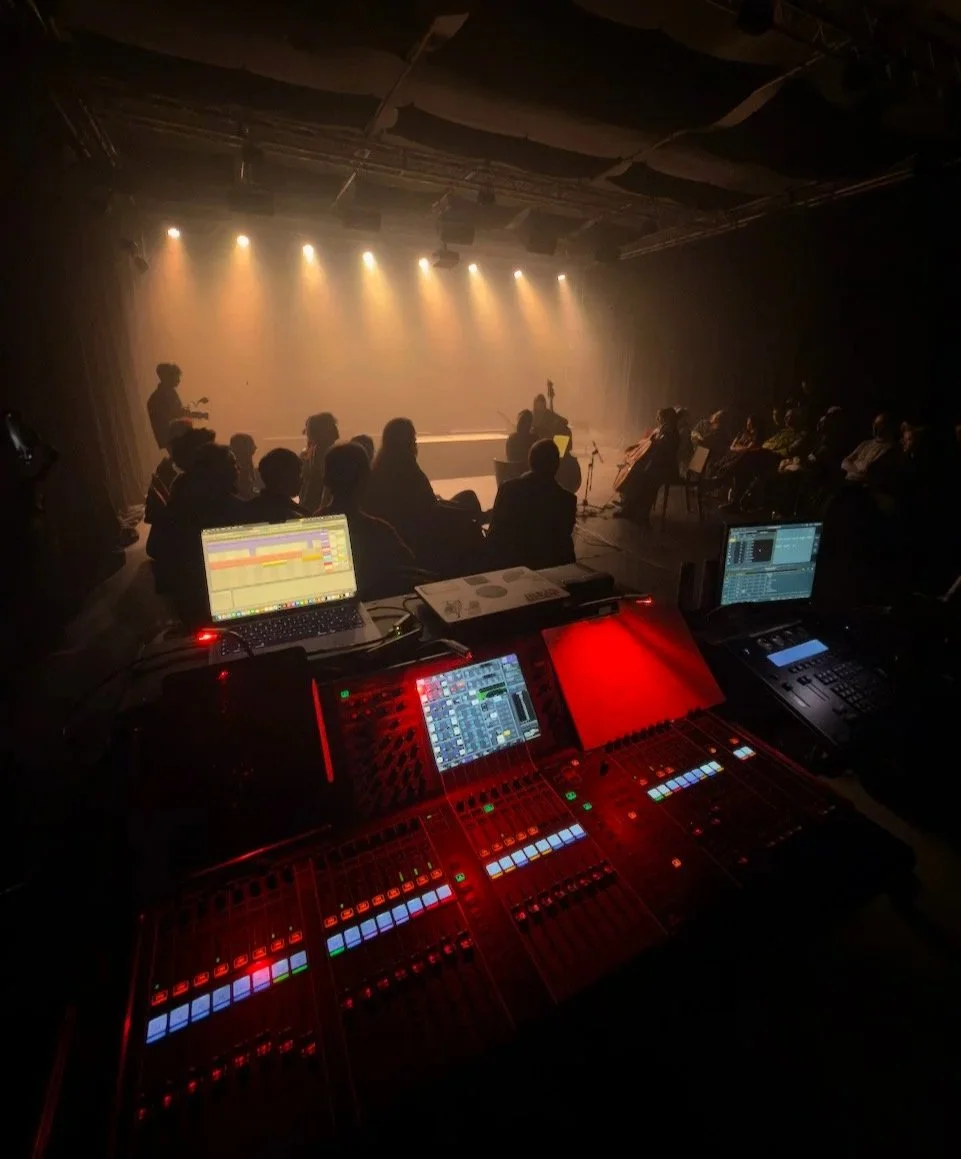
In his piece for Riot Ensemble, Phantom Miniatures, Tillegreen enlarges the musical context of the recorded vocal syllables by combining them with an acoustic string trio of violin, cello and bass. Loops were made from recordings of violinist Marie Schreer’s voice, working in both German and English. In practice, a great deal of experimentation and fine-tuning is required to find a viable phantom word illusion; being so subjective, the process is impossible to predict, and many word or syllable loops simply don’t produce anything of interest. For Phantom Miniatures, around fifty source words were tested, but of these only a small number could be used. Once these were chosen, the instrumental music was derived from elements of their loops – harmonies, overtones, rhythmic patterns and microtonal inflections. Sometimes that music acts as a kind of resonator of the recorded sounds, amplifying, boosting and elongating certain frequencies, while at others it acts in deliberate counterpoint, offsetting the recorded loops and possibly changing our perception of them.
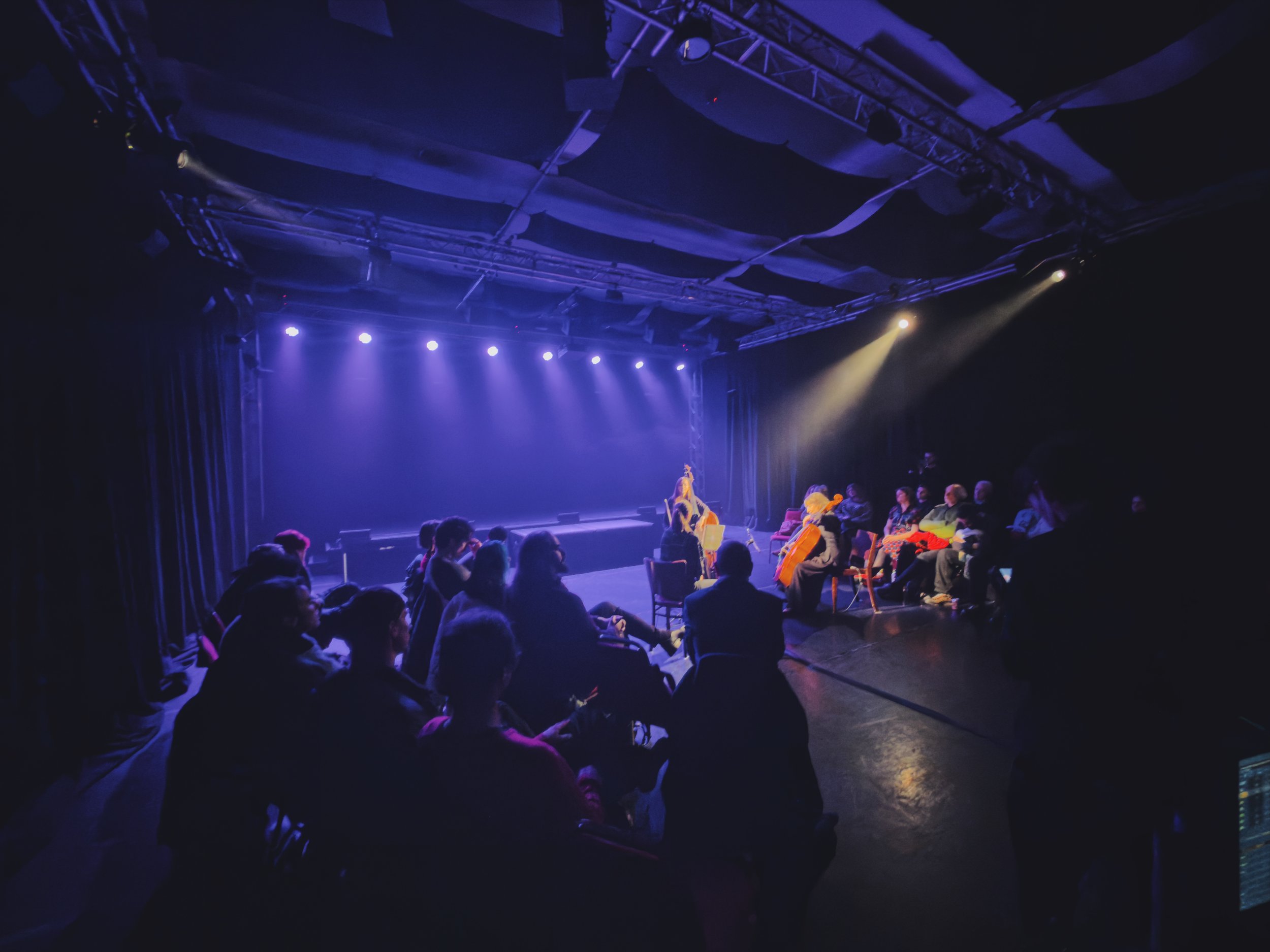
For brief moments, the acoustic music may even separate itself entirely from the recording, exploring the implications of the material it has extracted. This dynamic between congruence, difference and fantasy is illustrated well in the third section of the piece, which begins with a deeply droning double bass solo onto which a phantom word loop becomes imprinted.
Tillegreen’s process is related to the spectral composition of Gérard Grisey, in which the harmonic spectrum of an instrument is analysed and then separated into its constituent parts, before being resynthesised and re-inscribed across a large ensemble. The principal difference is that Grisey was working with the ostensibly abstract sounds of single instrumental notes, while Tillegreen is working with the concrete, semantic content of recorded voices.
And except, again – as the phantom word illusion illustrates – that semantic content is highly context-specific and practically infinite in meaning. Everything that is factually semantic is in fact apprehended as highly contingent and subjective, while everything that seems to be abstract – the instrumental rhythms, harmonies and timbres – acquires certainty and definition by comparison. This is the real loop into which Tillegreen places us: one in which meaning circles upon meaning, shuttling us back and forth between music and words, between sound and semantics, destabilising and solidifying at the same time.
Tim Rutherford-Johnson, March 2026