

Syzygy
Kings Place, 14 October 2022
David Del Tredici Syzygy (1966)
Naomi Pinnock (it looks like someone lived there) (2022)
Anna Korsun Ulenflucht (2016)
Alastair Putt Quincunx (2019)
‘Syzygy’: for a composer as enamoured of Lewis Carroll as David Del Tredici is, just the look of the word must have appealed: a vowel-less, almost symmetrical construction, seemingly nonsensical but with passing echoes of more familiar terms. In fact, it is not an invention but is used in astronomy, biology, poetry and maths to refer to the conjunction of two things that are otherwise independent of one another: chromosomes, metrical feet or celestial bodies, for example. It is the kind of word that James Joyce might have enjoyed too, and it is two poems by Joyce that Del Tredici sets in his ‘two songs for two groups’. Those two groups – a warm, chiming trio of soprano, French horn and tubular bells, and a chamber orchestra weighted towards pungent high and low winds – represent two opposites that are themselves brought into unexpected union.
The first poem, ‘Ecce puer’, is a short meditation on birth and death, composed by Joyce in 1932 on the birth of his grandson Stephen James and after the death of his father John Stanislaus. Joyce expresses this conjunction of opposites in a description of baby Stephen sleeping contentedly in his cradle, like a body in a coffin. Del Tredici’s music begins with a syzygy of its own: a duet of piccolo and double bassoon that is interrupted by tolling B naturals from the trio of soprano, horn and bells. Just as Joyce’s poem looks both forwards and back, Del Trediciwrites a musical palindrome, so that the tolling bells for the child born of ‘the dark past’ return for his concluding plea ‘O, father forsaken, forgive your son!’
While the soprano group captures lyricism, proclamation and solemnity in the first song, in the second, ‘Nightpiece’, it conveys the vast distances of stars seen from the streets of a smoggy Dublin: ‘Gaunt in gloom … Ghost-fires from heaven’s far verges’. The opposition is between stars and earth-bound smoke, in which Joyce finds ‘lost hosts’ of Seraphim and rising clouds of ‘bleak incense’ and Del Tredici realises as clouds of chiming fragments. Again, there is a musical symmetry – around Joyce’s wonderful ‘A starknell tolls’ – but this is not worked out as completely as in ‘Ecce Puer’ and in any case happens long past the poem’s (and the music’s) midpoint.
Naomi Pinnock’s (it looks like someone lived there)was commissioned by Riot and first performed by them at the Klangspuren Festival in Schwaz, Austria, last month. It sets words thought by Mrs Ramsay in Virginia Woolf’s To the Lighthouse – ‘now and again we rise to the surface and that is what you see us by’ – but in fragmentary form, as if the words themselves are submerged and barely breaking above the water. The voice is marked ‘abstract, as if an instrument’, and at first it appears a member of the instrumental ensemble just as much as flute, clarinet, bowed percussion or strings, distinguished only by alternating its notes with their chords, like the Woolfian swell of a wave. Later, as insistent interjections in a suspended ensemble texture, it takes on a more-human quality but only in highly circumscribed terms. Pinnock’s title too is derived from Woolf (down to its characteristic parentheses) and her description of the Ramsays’ abandoned holiday home on Skye becoming swallowed by the nettles and thistles: ‘here once some one had lived; there had been a house’. The house fell into ruins while World War I raged; in post-Covid 2022, the image of homes and the people inside them carries different connotations, but both Pinnock and Woolf share a fascination with humanity and the constructions that define and shape it.
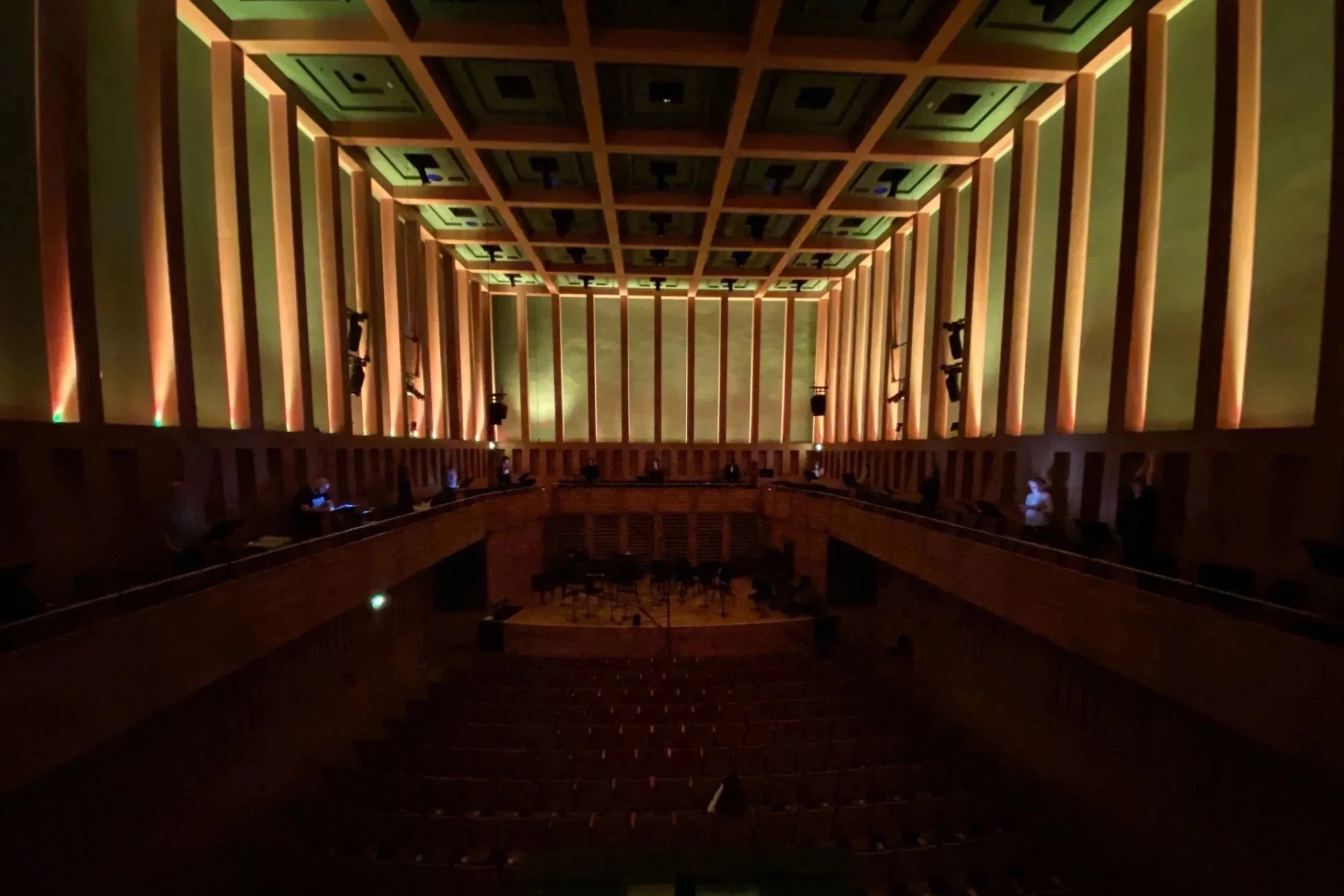
While Pinnock empties a space that might once have been full, Anna Korsun fills one we might otherwise perceive as empty. In her Ulenflucht (‘Time of the owl’s flight’) for 20 singers, a circle of singers positioned around the audience enacts a kind of ‘dusk chorus’ that emerges gradually, and then increasingly wildly, out of the background noise of the hall. Each augments the sound of their voice with between three and ten auxiliary instruments – plastic and cardboard tubes, toy instruments, and seventeen bird and animal calls (ranging from wolf to grouse). Korsun herself turned to these different sound sources simply as a way of reaching beyond the world of traditional instrumentation (Ulenflucht was anticipated by her electronic work The Time of the Owl’s Flight from 2015), but it is not hard to draw something more evocative from the sounds and their construction in time and space – a reversal of the radiant bloom of a dawn chorus into the nocturnal sounds of terror and predation.
The death in August 2022, at the age of 39, of Alastair Putt, robbed English music of a unique andbeloved voice. A singer and guitarist as well as a fastidious compositional craftsman, Putt wrote music fascinated by puzzles and patterns, both natural and mathematical. Quincunx was commissioned by Riot and written by Putt in 2019, but its intended first performance was delayed by the pandemic;unfortunately, its premiere tonight will not be heardby its composer. A quincunx is a typically Puttian inspiration: a cross shape made up of five points, variations on which may be found on dice or dominoes, in heraldry or in architecture. With the viola initially as its stable central point, Putt’s quintet of strings unfolds games of imitation and self-similarity that replicate like geometrical tiles.
Tim Rutherford-Johnson