

Spin
Kings Place, 30 April 2022
Jagoda Szmytka sky-me, type me (2011)
Joe Bates Sparrow (2020)
Alec Hall Spin (2021)
Jagoda Szmytka’s sky-me, type me was written long before the pandemic, but concerns what became one of its most ubiquitous features: the video call. Unlike an ear or an eye, a digital microphone or camera captures everything within its field of perception, filters nothing, foregrounds all of it equally and without discrimination. (2020’s Zoom did a little filtering; Szmytka’s 2011 Skype not so much.) On screen, the complexities of face-to-face conversation are flattened into two dimensions, and extraneous sounds, background noise, breaks or interruptions, glitches in the technology all acquire the same profile as the actual words of speech. There is something Carrollian about this that we might also recognise in our own pandemic experiences: Alice, falling down the rabbit hole, loses all perspective of time and space. Small can become big, big become small. The world comes to turn on, and be constructed from, small talk, ephemera and system errors.
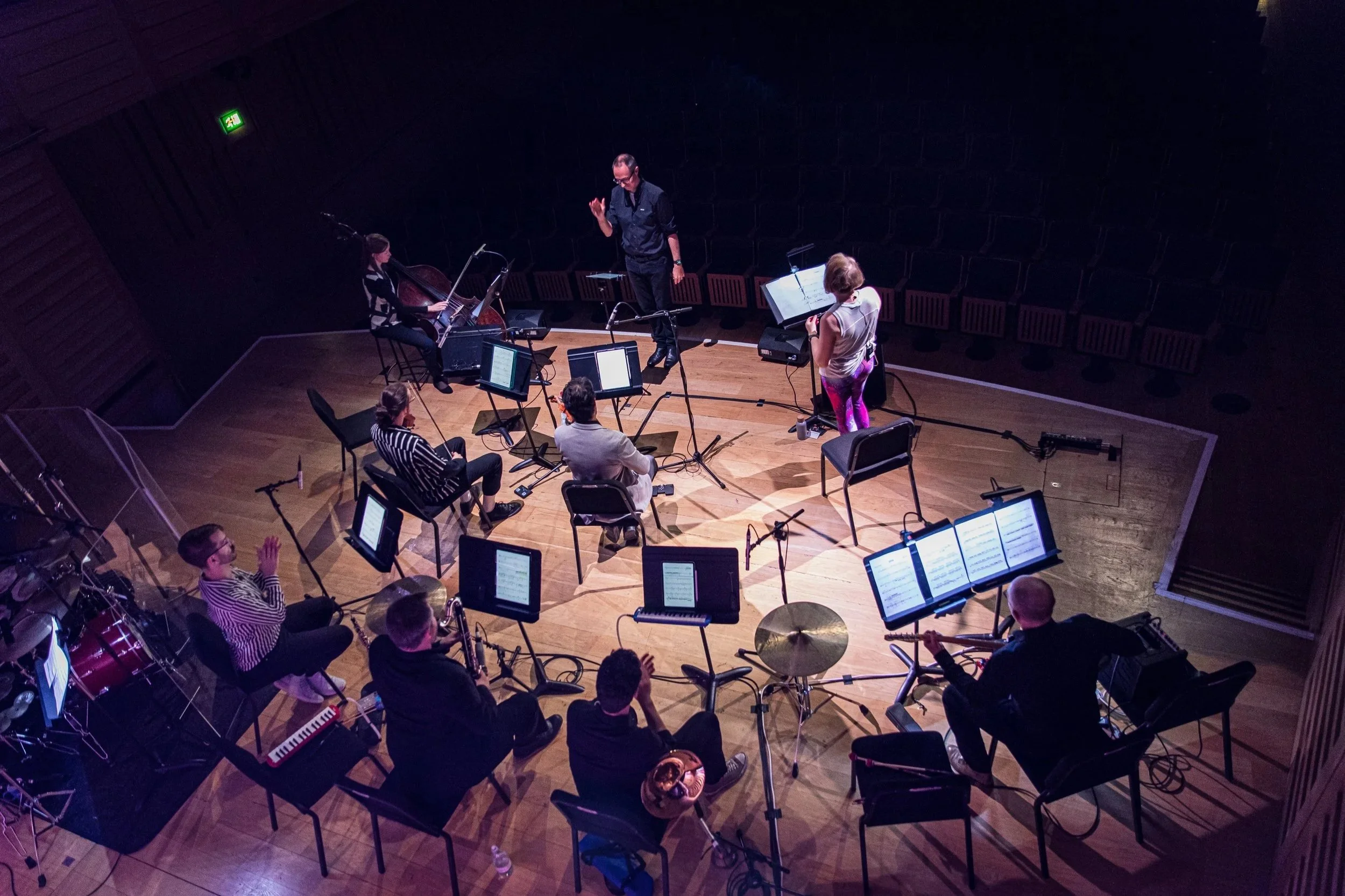
Szmytka’s four performers sit with their backs to us (already denying us the cues of body language and facial expression) and sing/speak/play into four electronic megaphones, whose horns point towards us. Making a virtue out of the sonic presence of her technological mediation, every aspect of the megaphones is mined for sonic content: on-off switch, microphone position, hand, static, feedback, as well as different vocal phonemes, pitches and mouth shapes. When words do finally emerge towards the end of her piece, they are thoroughly caught up in the snag and crackle of the medium. We too are falling down the rabbit hole, but at least Alice is with us.
Joe Bates’s Sparrow for double bass is one of dozens of solo works commissioned by Riot (and premiered on YouTube) in support of composers during the pandemic. It is inspired by the view behind the Kilburn flat in which Bates, his partner and three friends saw out the first Covid lockdown: a typical London canyon of gardens and railway line running between high-backed Victorian terraces. In the depths of lockdown, sparrows had exclusive access to this domain, flitting between empty commuter trains and families confined to their gardens. Sparrow is not representational as such: for a start, portraying such a small bird on such a large instrument is an amusing inversion of scale. And Bates’s work contains little of the characteristic fidgety chatter of sparrows in a hedge that recalls teenagers hanging around a bus stop after school. Instead, it is evocative of that strange spring in which human life retreated a little and nature expanded: the sparrow’s more-than-humanness captured in chiming microtones and harmonics, like the court music of short-lived empire.
The inspiration for Alec Hall’s Spin (2021) is Peloton. If you’ve not had the pleasure, Peloton sells fitness equipment and online exercise classes. Whenall the gyms were closed, home workout systems became very popular, and Peloton was one of the most successful. Its unique selling point is its internet-connected exercise bikes, which come with touchscreens through which you can stream classes by Peloton instructors while you work out. You can – of course – video chat with other users or even watch footage of the scenery passing by.
Words by three of those instructors, Jess King, Emma Lovewell and Cody Rigsby, feature in Spin, which takes something like the form of a Peloton class, beginning with a warm-up and moving through various levels of intensity and encouragement through to a climactic moment of self-affirmation. But – as with every activity we did at home during lockdown, which felt equal parts mundane and immensely significant – there’s a little more to it than that. Because as we pedal our stationary bike, its spinning wheel becomes a spinning wheel, drawing in whatever loose fibres of thoughts and recollections it can attract and spinning them out as a single, tangled thread of pop-cultural memories and hidden anxieties.
It begins with the music of the Peloton class itself – a motivational high energy playlist curated by the instructors themselves. (Is that a hint of a Jimi Hendrix riff?) But soon it sucks in memes and cartoon voices (Larry David? Big Mouth’s Lola Skumpy?) ‘This is the magic, Peloton!’, cries the instructor, offering encouragement by calling out the names of class participants. ‘You’re all a part of this community’. Some of those names shouldn’t have got past the filter. Did we imagine that one? Things take a surreal turn. ‘The moon is our disco ball tonight and I want you to swirl’. Are we sure what’s happening now? How much longer can I go on?
‘You are not good enough’.
Excerpts from ‘Litany of Self-Loathing’ by the American poet Vanessa Place are dropped into the vortex, like cream into coffee, but the spinning is too fast now to make out which is which in the blur: motivation or disgust, instructor or subconscious. And what is outside, anyway, if you are only inside? And still the wheel spins faster: the instructions become confessions, the class a Penitential Act. It takes in everyone: singer, musicians, conductor, audience. Finally, sick on Smirnoff Ice, McDonald’s and self-hatred, we launch our floor-fixed bikes in search of absolution.
Tim Rutherford-Johnson