

Extinction Events
Kings Place, 14 February 2020
Aaron Holloway-Nahum Like a memory of birds (ii) (2019)
Laurence Osborn Ctrl (2017)
Liza Lim Extinction Events and Dawn Chorus (2017)
It is a wonder and a horror of our age that the songs of extinction will be preserved. Go online and we can find – in digital form and always, forever – the sounds of species that no longer exist. Songs heard and conserved in alien landscapes, looped and replayed until … when? Google the Hawai’ian Kaua‘i ‘ō‘ō bird and you can hear its curving, circling song. But this bird was the last of its species:it died three decades ago.
The song in Aaron Holloway-Nahum’s Like a memory of birds (ii) is stylized and does not imitateany particular species (the piece is a sequel to a 2017 work for marimba and cor anglais). But its setting recalls the Kaua‘i ‘ō‘ō’s online avatar. The songtakes the form of a duo between clarinet and bass clarinet. It is shared between them, but dips in and out of alignment, like echoes in a forest. Its surroundings are malleable and uncertain: soft string harmonics and the eerie whistle of corrugated plastic pipes increasingly give way to the hard-edged timbres of piano and drums. As background becomes foreground the clarinets’ song is overwhelmed and almost entirely forgotten, until a habitat becomes no more than a space.
In Laurence Osborn’s Ctrl, the song is a football chant (one familiar to Arsenal fans in particular). Soprano Sarah Dacey appears, amplified, autotuned and in male character, to sing a threnody to failed masculinity. ‘Body is amazing’, she sings, ‘Body is equipped for work and sex and sport. Me and my body, we do what we want.’ The music cycles and swells: the sweat and surety of Beethoven and the moshpit. But the chant is a lament, the bravado a lie, the story toxic. The third movement is a dark lullaby in which strength dies in a Beckettian repetition of hangovers and despair: ‘Saturday morning … Black blinds … At the bottom of everything.’ Hopeless? No: the work ends with a plea, with tenderness, and a last-ditch desire to reach out.
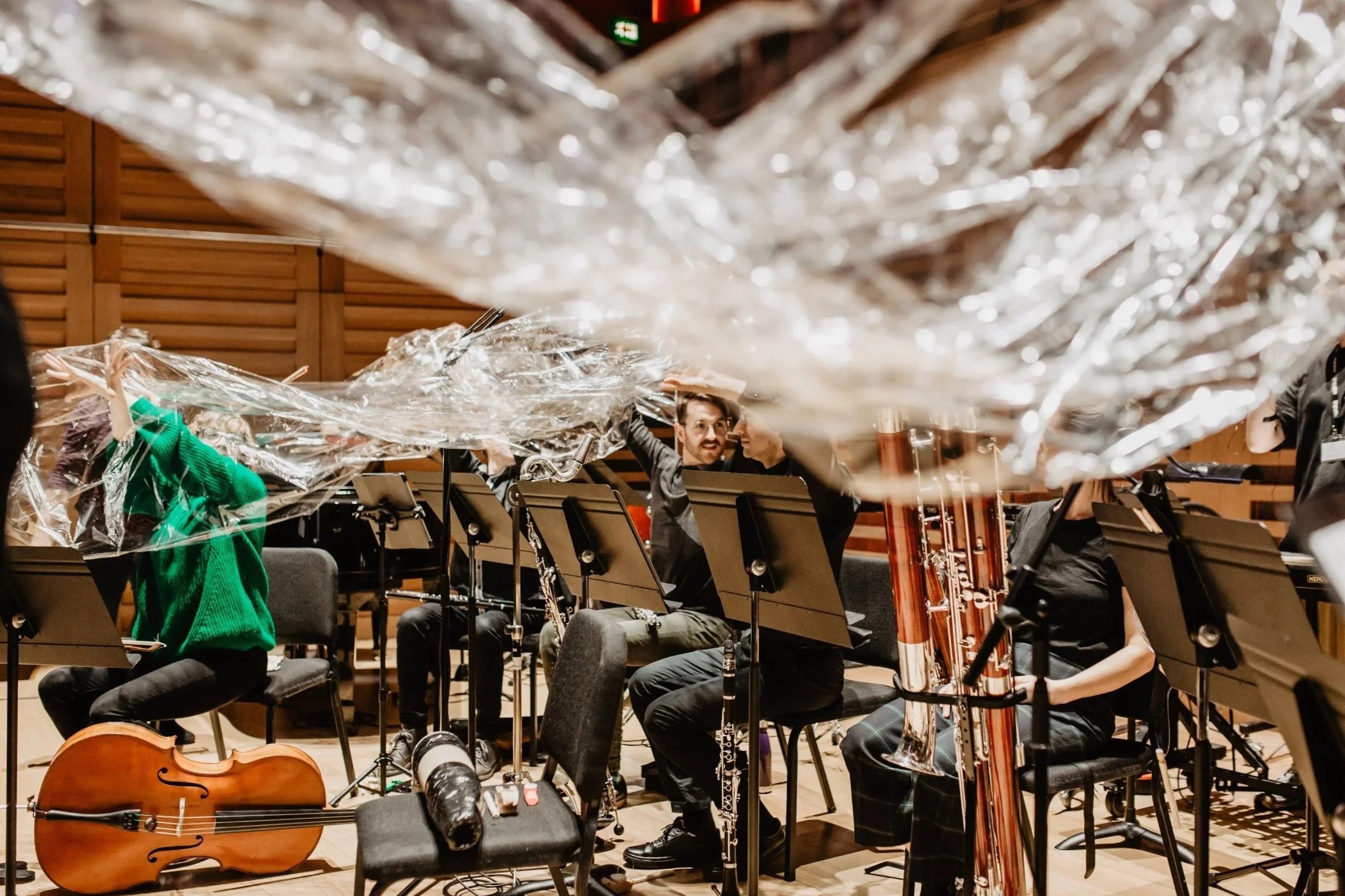
Late in the day, humanity is realising the harm its relentless drive to acquire, occupy and consume is doing to a habitable planet. In its first movement, ‘Anthropogenic debris’, Liza Lim’s Extinction Events and Dawn Chorus sets the tone of ecological crisis. The debris in question is the vast collections of plastic that have ended up in the world’s oceans and have been gathered by circulatory currents (known as gyres) into giant, swirling patches of rubbish and pollutants. As they turn, plastic is drawn into them and then ground into smaller and more dangerous particles – which themselves pose an existential threat to life on Earth. As well as a large sheet of cellophane that is absorbed into its percussion section, Lim’s piece is full of representations of looping and turning, as well as degradation and loss: she transcribes the song of the Kaua‘i ‘ō‘ō; recycles a violin solo of her own, based on tracings of a ninth-century Chinese star map; and inserts allusions to historical music, in the form of bars from Leoš Janáček’s late-Romantic piano piece On an Overgrown Path. All of them represent forms of extinction. The star map predates Western astronomy by five hundred years, but its achievement has been erased by history. The Kaua‘i‘ō‘ō’s mating call will never be answered. The Janáček, warped almost beyond recognition in Lim’s piece, was described by its composer as comprising reminiscences ‘so dear to me that I do not think they will ever vanish’.
Circulation also entails slippage: as debris loops back, it recalls both the past and its present. Slippages occur on every level, whether the timbres of brass instruments playing unstable half-valve sounds (as in the opening duo between horn and trumpet), or the larger-scale slippage of identity in the fourth movement, in which a solo violin attemptsto ‘teach’ or transmit her music to a percussionist playing a rudimentary string drum.
The last movement is based on another real – and extraordinary – singing phenomenon: the ‘dawn chorus’ of coral reef fish that takes place in the changing light of morning. Lim recreates this mass of clicking, rasping percussive sounds through the sound of Waldteufels (small string drums) and windwands being swirled in the air – an effect that is as visual and tactile as it is sonic. Plastic returns, in the form of a one-metre tube that extends the range of a contrabassoon theoretically below the edge of human hearing. And so the final song is one that we can no longer know nor understand, pointing to a future perhaps no longer meant for us.
Tim Rutherford-Johnson